I think that’s probably a correct assessment in respect to their approach to their work. There are two instances in my experience that confirm this statement
I remember a clip from a video I have of Fred Cuming RA painting outdoors ‘sur le motif’. The painting was quite advanced when suddenly he took a 3 inch house painters brush and covered a large middle distance section with a neutral grey. Drastic – but clearly the painting was not going well.
Even more surprising was Lars Jonsson’s complete removal of a bird from one of his paintings. In one of his books he showed a step by step demonstration of an oil painting. It showed a group of six partridges in snow. All of the birds were nearing completion when the next frame had a foreground bird covered with white paper. Sure enough in the final stage the bird had gone and he used a line of bird’s footprints to lead the eye in to the main group.
The lesson is that however much effort has been put in if things are not going well ruthless rubbing out may be the only solution.

Tuesday, November 29, 2011
Friday, November 25, 2011
RAMSEY ISLAND
I’m working hard with Acrylics at the moment exploring the working properties of the Golden Open brand. They’re a terrific improvement on existing heavy body acrylics and paint put out on the palette will stay workable for a week before it begins to skin over – that is if the palettes is covered over and sealed - (I use a plastic box with a close fitting lid.)
At present I’ve got three new paintings on canvas supports on the go but for extra practice I’m also reworking older paintings.The first version of Ramsey Island dates back to 1991. I used Rowney Cryla or Liquitex on 6mm mdf board. These are the original sketchbook drawings made on a summer holiday in Pembrokeshire.

The reworked version developed from seeing a rather overcast evening sky through the studio window.

Ramsey Sound has a group of rocks known as ‘The Bitches’ which are a hazard when the tide is low. I’ve been able to indulge my current fascination with birds by changing some of them into a flight of Oystercatchers.

The reworked version developed from seeing a rather overcast evening sky through the studio window.

Ramsey Sound has a group of rocks known as ‘The Bitches’ which are a hazard when the tide is low. I’ve been able to indulge my current fascination with birds by changing some of them into a flight of Oystercatchers.
Wednesday, November 23, 2011
‘THE FRUITS OF ENTHUSIASM’: JAMES SELLARS 1927 – 2000

Sorting through some of my sketchbooks today I came across a
booklet printed to accompany an exhibition of James Sellars life and work.
James Sellars taught at the
Hereford and Southampton Colleges of Art. He developed a range of painting styles suited to
the medium he was using. He worked in pastel, tempera, gouache, etching,
aquatint, and lithograph.
There is a link to ‘The Brotherhood of Ruralists’ website
which has an illustrated page about him.
http://ruralists.com/features/sellars/index.html
Collage also was a significant feature of his creative
output – a technique which was adopted enthusiastically by his students. The
cover design was produced by one of them. It’s a lovely arrangement of decorative
shapes which also uses strong colour to good effect. The balanced placing of the printed title
works well and the use of a sans serif font is entirely appropriate.
I wish that designs for our Ludlow Art Society Exhibitions
were conceived in a similar direct way. There is a valuable lesson to be
learned from a study of collage for designing publicity material. The following is another link which gives more information about
the artist.
http://www.herefordshire.gov.uk/council_gov_democracy/news/25793.asp
http://www.herefordshire.gov.uk/council_gov_democracy/news/25793.asp
Tuesday, November 15, 2011
STEWART ISLAND

Stewart Island is located off the southern tip New Zealand. It
is wild, and unspoiled. I was there last February and after a rather hectic
week I felt in need of quiet solitude. I
spent the week-end reliving the experience through photographs I’d taken
searching for subjects to paint.
It is a natural paradise and a haven for wildlife. A guided
walk on Ulva Island a protected nature
reserve in Half Moon Bay in heavy rain promised a sighting of South Island
Kiwis which are not nocturnal. I think the rain must have kept them under cover
but one flightless bird did present itself. A Weka which was browsing in the bush just a few feet
away from the footpath and quite unconcerned by the walking party.
For this sketch I’ve used Liquitex Acrylic on Canson pastel
paper.
Monday, November 14, 2011
The Local Sparrowhawk.

He's the 'invader' I mentioned on the earlier blog. It's always good when he pays a visit because he's an interesting bird to draw. I hope he won't outstay his welcome by making his visits too frequently!
PESTERED BY 'THE INVADERS'
Activity on my bird feeders has virtually ceased. Last week it was the local Sparrowhawk that provided some excitement. I caught a back view of a grey bird on the lawn that I assumed was a pigeon until it raised its head and looked around. Sure enough there was the hooked yellow bill and sharp eyes. The birds on the feeders took flight and he set off in pursuit.
I assume he didn't make a kill because he was back briefly on his branch in the apple tree. He was off before I had chance to take a photograph all I could manage was a scribble from memory. It was annoying because he presented a back view and I wanted to study the tail feathers particularly the underside. There was a brief moment of hope when he presented himself on the ash tree at the end of the garden. Hope was dashed when he changed his perch and presented a front view where he would have had a clear view of the feeders.
The 'regulars' kept away never to return that day. At the week-end there was an invasion of Jackdaws and today they were back together with four healthy looking magpies. The Jackdaws and magpies have acquired the skill of clinging to the fat ball feeders and pecking away to provide pickings for their mates waiting on the ground below.
Once they're away the resident Great Spotted Woodpecker returns to claim his place on the nut feeder and a few tits and greenfinches return for seeds. No sign of the Chaffinch and Goldfinches we used to get browsing the lawn.
I assume he didn't make a kill because he was back briefly on his branch in the apple tree. He was off before I had chance to take a photograph all I could manage was a scribble from memory. It was annoying because he presented a back view and I wanted to study the tail feathers particularly the underside. There was a brief moment of hope when he presented himself on the ash tree at the end of the garden. Hope was dashed when he changed his perch and presented a front view where he would have had a clear view of the feeders.
The 'regulars' kept away never to return that day. At the week-end there was an invasion of Jackdaws and today they were back together with four healthy looking magpies. The Jackdaws and magpies have acquired the skill of clinging to the fat ball feeders and pecking away to provide pickings for their mates waiting on the ground below.
Once they're away the resident Great Spotted Woodpecker returns to claim his place on the nut feeder and a few tits and greenfinches return for seeds. No sign of the Chaffinch and Goldfinches we used to get browsing the lawn.
Saturday, November 05, 2011
Pied Stilts, Lake Okaro.

Wednesday, November 02, 2011
Welcome Visitors

Friday, October 28, 2011
My website: a rebuild
I've been preoccupied with my website for the past two or three days it's been badly neglected and I decided to make some
changes. Now my current interest is wildlife – mainly birds – I decided to add a Wildlife Gallery. I started the website as a
collection of pages which were medium specific - Watercolour, Pastel, Sketchbooks ie Drawings, and Digital. The Wildlife
page is subject or genre orientated and it seemed best to show the works together rather than disperse them in the different
media galleries.
When setting up a website the earliest advice I was given was to keep to a simple presentation. So I've always avoided moving text or motifs for banners – they may have a place for eye-catching adverts but they are a distraction on an artistic website. Back in 1999 I made a trip to New Zealand and met Grahame Sydney at his retrospective in Dunedin, He's New Zealand's most successful artists - a wonderful painter. I only mention this because his website is plain simplicity and it served as a model for my first designs. Since then I've added colour to my pages but I've tried to preserve simple clarity as a fundamental principle of design..
What began as the addition of a Wildlife Gallery page turned out to be a major rebuild which is taking much longer than anticipated. Files that once displayed well are now all over the place. Fortunately the newly added Wildlife Gallery seems to be working as was intended. For the purpose of displaying pictures I'm thinking pure simplicity works best. Take a look at Graham Sydney's website to see what I mean..
http://www.grahamesydney.co.nz/
When setting up a website the earliest advice I was given was to keep to a simple presentation. So I've always avoided moving text or motifs for banners – they may have a place for eye-catching adverts but they are a distraction on an artistic website. Back in 1999 I made a trip to New Zealand and met Grahame Sydney at his retrospective in Dunedin, He's New Zealand's most successful artists - a wonderful painter. I only mention this because his website is plain simplicity and it served as a model for my first designs. Since then I've added colour to my pages but I've tried to preserve simple clarity as a fundamental principle of design..
What began as the addition of a Wildlife Gallery page turned out to be a major rebuild which is taking much longer than anticipated. Files that once displayed well are now all over the place. Fortunately the newly added Wildlife Gallery seems to be working as was intended. For the purpose of displaying pictures I'm thinking pure simplicity works best. Take a look at Graham Sydney's website to see what I mean..
http://www.grahamesydney.co.nz/
Tuesday, October 18, 2011
Surprise Visitor

Sunday, October 16, 2011
ORFORD MEMORIES

Other memories which linger are of the small groups of avocets on the waters’ edge of Havergate. So I’ve included a little group of four. Strictly they’re in quite the wrong place. But does it matter when you’re painting a fond memory?
Tuesday, October 11, 2011
Magritte at Tate Liverpool
I went to see the Magritte exhibition today - pleased to have seen it before it closes. What an odd imagination he had. I love the way he plays with representation and reality. He paints a representation which the viewer reads as a smokers pipe then titles it; "This is not a pipe". In another work he turns the idea around. A framed painting of a slice of cheese is placed in a 'Cheese Dome' - the title this time is "This is a piece of cheese". There are other paintings where he confuses what is actuality and what is painted.
The paintings of this genre are ingenious and amusing - they have more appeal for me than the strange and disturbung surreal works. A bird morphing into a leaf which is being eaten by a caterpillar a bit grotesque and unnatural. There are many more which are strange associations of recognisable things. A face with roses painted where the eyes normally are.
What do they mean? Magritte claimed they do not mean anything -" because mystery means nothing eiither, it is unknowable." Perhaps that's all that needs saying. It was a huge exhibition and it took a lot of concentration to try and take it all in. I'm glad I made the effort to travel to Liverpool to see it.
Sunday, October 09, 2011
SUFFOLK DIARY 3
HAVERGATE ISLAND 28th September 2011
A beautiful day gave the prospect of visiting the RSPB Reserve on Havergate Island. A boat trip round the Island from Orford offered easier travel arrangements. It was a worthwhile trip – there was a lovely view back to the town as the boat left which would be a good subject for a watercolour. The first bird sightings were gulls and a Grey Heron then what we were waiting to see – Avocets.

Then followed a view of a pair in different poses

The problem with observing from a moving boat is that there is no time to observe behaviour or make sketches. I was forced to rely on photographs and work up sketches from them.

These three arriving offered a nice opportunity for a painting. I’ve used a mid-toned 160gsm Ingres pastel paper to show up the mainly white birds. White is a difficult colour to modulate. White feathers sometime reflect blue on other parts of the bird the impression can be of a warm grey. There are always subtle changes. A flock of 12 or more Avocets flew over going roughly North. Were they making for Minsmere where we’d had little success 3 days ago?

Avocet and Gull: Watercolour
Then followed a view of a pair in different poses

Two Avocets: Watercolour
The problem with observing from a moving boat is that there is no time to observe behaviour or make sketches. I was forced to rely on photographs and work up sketches from them.

Three Avocets whiffling in to feed: Watercolour with Chinese White.
These three arriving offered a nice opportunity for a painting. I’ve used a mid-toned 160gsm Ingres pastel paper to show up the mainly white birds. White is a difficult colour to modulate. White feathers sometime reflect blue on other parts of the bird the impression can be of a warm grey. There are always subtle changes. A flock of 12 or more Avocets flew over going roughly North. Were they making for Minsmere where we’d had little success 3 days ago?
Wednesday, October 05, 2011
SUFFOLK DIARY 2
MINSMERE 25th September 2011
Made a second visit in the hope of catching sight of Avocets. The birds again favoured the eastern pool of The Scrape so the long walk to the East hide offered the best prospects.
The first bird encounter was some nesting Cygnets seen on the bank of a small stream near the path to the West Hide. There were five in all preening intermittently – I drew the most active ones.
 Drawn on cartridge paperwith Pentel Sepia Colour brush and a Wash brush.
The next stop was the South Hide. A Grey Heron was standing on a rocky spit in a small pool among the Reed Beds.
 The outline drawing was made with a Pentel Brush Pen. The black ink in the brush pens is waterproof which is fine if the paper is heavy enough to take watercolour washes. The background in this drawing was added with soft pastels.
There was more activity to be seen from the coastal path leading to the East Hide. A flock of six ducks took flight from the Scrape Pool. I caught this impression of the leading four with the help of a long lens shot. The photograph had reasonable focus but the only certain detail was the white tail feathers. So I’m still trying to identify them
 Watercolour on 160 gsm Ingres Pastel paper highlighted with Chinese White.
From the East Hide there were good views of geese, ducks and waders resting or feeding on the extensive gravel areas of the Scrape. Four Avocets flew in but they chose to feed off the far edge of one of the gravel islands so offered only the occasional glimpse. I settled for a sketch of a pair of Barnacle Geese.
 Watercolour on 160 gsm Ingres Pastel paper highlighted with Chinese White.
The last sighting on the way back to the Visitor Centre was the Konig Polski ponies browsing in the Konig Field. This is a sketch of the most inquisitive one.
 Watercolour on 160 gsm Ingres Pastel paper highlighted with Chinese White.

The next stop was the South Hide. A Grey Heron was standing on a rocky spit in a small pool among the Reed Beds.

There was more activity to be seen from the coastal path leading to the East Hide. A flock of six ducks took flight from the Scrape Pool. I caught this impression of the leading four with the help of a long lens shot. The photograph had reasonable focus but the only certain detail was the white tail feathers. So I’m still trying to identify them

From the East Hide there were good views of geese, ducks and waders resting or feeding on the extensive gravel areas of the Scrape. Four Avocets flew in but they chose to feed off the far edge of one of the gravel islands so offered only the occasional glimpse. I settled for a sketch of a pair of Barnacle Geese.

The last sighting on the way back to the Visitor Centre was the Konig Polski ponies browsing in the Konig Field. This is a sketch of the most inquisitive one.

Sunday, October 02, 2011
SUFFOLK DIARY
A DAY AT MINSMERE 25th September 2011
Today's plan was to visit 'The Scrape' to see the RSPB’s flagship species – the Avocet. But no they seem to have all flown. The consolation prize was a Little Egret foraging among the reeds.

Then also from the West Hide a Hobby in some rough vegetation on the edge of The Scrape.

There had been a reported sighting of a Snow Bunting but I had no luck. No luck either with any sightings of Bearded Tits in spite of possible sounds. So we took the newly made Reed Trail ever hopeful. Had to settle for a distant view of the Konic Polski ponies – curse myself now for not trying a long lens shot. The ponies have been brought in to graze the wetlands.
The next objective was the Bittern Hide an elevated structure accessed by 4 flights of steps and looking out over extensive reed beds. There are a stretch of reeds where the Bitterns should have been 'booming' – but they were silent! Sections of reeds have been flattened to make the area more Bittern friendly. One of these provided another consolation – two juvenile pheasants.

So I took the homeward trail through woodland stopping to record an Ink Cap Fungus.

Then a final sighting of a small group of Red Deer browsing among the trees to round off an interesting day.


Then also from the West Hide a Hobby in some rough vegetation on the edge of The Scrape.

There had been a reported sighting of a Snow Bunting but I had no luck. No luck either with any sightings of Bearded Tits in spite of possible sounds. So we took the newly made Reed Trail ever hopeful. Had to settle for a distant view of the Konic Polski ponies – curse myself now for not trying a long lens shot. The ponies have been brought in to graze the wetlands.
The next objective was the Bittern Hide an elevated structure accessed by 4 flights of steps and looking out over extensive reed beds. There are a stretch of reeds where the Bitterns should have been 'booming' – but they were silent! Sections of reeds have been flattened to make the area more Bittern friendly. One of these provided another consolation – two juvenile pheasants.

So I took the homeward trail through woodland stopping to record an Ink Cap Fungus.

Then a final sighting of a small group of Red Deer browsing among the trees to round off an interesting day.

Thursday, September 22, 2011
THE EXCITEMENT OF BRUSH DRAWING
A well-pointed brush is a wonderfully expressive drawing instrument. Some years ago I enrolled for a course on Chinese painting and the tutor set us off drawing bamboo – a basic motif – as a first exercise. I never really took to Chinese painting but I became hooked by the excitement of making expressive marks with a well charged brush.

This drawing owes something to the direct watercolour studies in Darren Woodhead's book 'Up River: The Song of the Esk.' but I've used a simple monochrome treatment rather than full colour. My basic method is to draw with a Pentel Sepia Colour Brush and use a 'Pentel Wash Brush' to soften and blend the brush marks. The difficulty with this basic method is to create mid-tones. So in this drawing I've used an extra wash brush filled with diluted calligraphic ink.
The drawing was made in the studio and I haven't tried to depict any particular species. But the sketch is based around some of the winter visitors attracted to a bird feeder hung in an apple tree in the garden.
A well-pointed brush is a wonderfully expressive drawing instrument. Some years ago I enrolled for a course on Chinese painting and the tutor set us off drawing bamboo – a basic motif – as a first exercise. I never really took to Chinese painting but I became hooked by the excitement of making expressive marks with a well charged brush.

This drawing owes something to the direct watercolour studies in Darren Woodhead's book 'Up River: The Song of the Esk.' but I've used a simple monochrome treatment rather than full colour. My basic method is to draw with a Pentel Sepia Colour Brush and use a 'Pentel Wash Brush' to soften and blend the brush marks. The difficulty with this basic method is to create mid-tones. So in this drawing I've used an extra wash brush filled with diluted calligraphic ink.
The drawing was made in the studio and I haven't tried to depict any particular species. But the sketch is based around some of the winter visitors attracted to a bird feeder hung in an apple tree in the garden.
Wednesday, September 21, 2011
DARREN WOODHEAD
I'm a great admirer of Darren Woodhead's interpretations of the natural world. He works from direct observation outdoors and uses watercolour in a free expressive way to record his subjects.
I've never seen Darren's paintings displayed gallery wall so I'm afraid my enthusiasm has been generated from his book 'Up River: A Song of the Esk' and the paintings displayed on his website at:
www.darrenwoodheadartist.co.uk
I find Darren's kind of painting much more interesting than the more studied realist work done in the studio. You have to admire the effort that some artists put in to achieve photographic detail - and maybe that is what many collectors look for. Personally I fear that painterly qualities are often lost in photo realist paintings. When you look at the work of artists like David Sheppard for instance you quickly become aware of his brush work which confirms that you're looking at a painting not a photograph.
I'm a great admirer of Darren Woodhead's interpretations of the natural world. He works from direct observation outdoors and uses watercolour in a free expressive way to record his subjects.
I've never seen Darren's paintings displayed gallery wall so I'm afraid my enthusiasm has been generated from his book 'Up River: A Song of the Esk' and the paintings displayed on his website at:
www.darrenwoodheadartist.co.uk
I find Darren's kind of painting much more interesting than the more studied realist work done in the studio. You have to admire the effort that some artists put in to achieve photographic detail - and maybe that is what many collectors look for. Personally I fear that painterly qualities are often lost in photo realist paintings. When you look at the work of artists like David Sheppard for instance you quickly become aware of his brush work which confirms that you're looking at a painting not a photograph.
Tuesday, September 20, 2011
LAPWING SKETCHES
Searching for subjects for my next painting I came across these drawings of lapwings from March 2010. They are some of the first drawings I did from a hide viewing the birds through a newly acquired telescope.

There are three pages of similar sketches showing different poses to there is enough material to make an interesting picture.
Searching for subjects for my next painting I came across these drawings of lapwings from March 2010. They are some of the first drawings I did from a hide viewing the birds through a newly acquired telescope.

There are three pages of similar sketches showing different poses to there is enough material to make an interesting picture.
Wednesday, September 14, 2011
BEYOND PHOTOGRAPHY
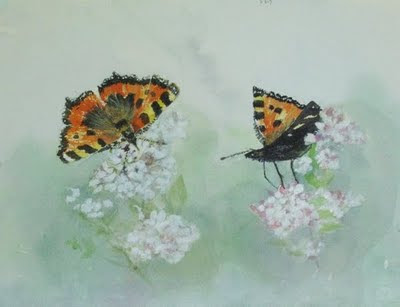
I was aiming to make these studies of butterflies into a painting but I’ve reached an impasse. I didn’t want to present them separately as vignettes though the form has a long history. Chinese painters were very adept at catching the spirit of living things with a few beautifully formed brush strokes. Technical illustrators go to the other extreme taking the long stare route to record accurate detail but often only giving the merest suggestion of their subject’s environment.
Normally if I’m planning a painting I make drawings of the subject’s habitat en plein air when I can. This isn’t always possible if you are sketching or taking photographs of a bird or animal in a wildlife park but the difficulty is not insoluble. I took 10-12 digital photographs of this butterfly before it flew out of range. I was using a medium range telephoto lens set to 70-100mm to ensure the insect filled a good proportion of the screen. With camera studies of insects the photographer’s concerns are primarily sharp focus to record detail and whether his lense is giving good bokeh.
My objectives as a painter are not concerned with photo realism and precise detail. I’m more interested catching characteristic or unusual behaviour particularly if this can be expressed by painterly means. I’m a great admirer of Lars Jonsson, his bird paintings show sufficient detail for identification but he uses a freer style to record the bird’s habitat.
I’ll break the impasse I’m in with the butterflies eventually but it will need some research into appropriate plants to compose a background.

I was aiming to make these studies of butterflies into a painting but I’ve reached an impasse. I didn’t want to present them separately as vignettes though the form has a long history. Chinese painters were very adept at catching the spirit of living things with a few beautifully formed brush strokes. Technical illustrators go to the other extreme taking the long stare route to record accurate detail but often only giving the merest suggestion of their subject’s environment.
Normally if I’m planning a painting I make drawings of the subject’s habitat en plein air when I can. This isn’t always possible if you are sketching or taking photographs of a bird or animal in a wildlife park but the difficulty is not insoluble. I took 10-12 digital photographs of this butterfly before it flew out of range. I was using a medium range telephoto lens set to 70-100mm to ensure the insect filled a good proportion of the screen. With camera studies of insects the photographer’s concerns are primarily sharp focus to record detail and whether his lense is giving good bokeh.
My objectives as a painter are not concerned with photo realism and precise detail. I’m more interested catching characteristic or unusual behaviour particularly if this can be expressed by painterly means. I’m a great admirer of Lars Jonsson, his bird paintings show sufficient detail for identification but he uses a freer style to record the bird’s habitat.
I’ll break the impasse I’m in with the butterflies eventually but it will need some research into appropriate plants to compose a background.
Monday, September 12, 2011
FIELDWORK
I’ve always been astonished by Charles Tunnicliffe’s sketches made in the field. The two books that have been published of his drawings. ‘A Sketchbook of Birds’ and a later one ‘Sketches of Birdlife’ give a wonderful insight into his methods.
My favourite though is ‘The Peregrine Sketchbook’ which is made up of sketches based on observations of a nest on South Stack, Anglesey. Most of the text and illustrations are taken from Tunnicliffe’s ‘Shorelands Summer Diary’. There are annotated sketches made in the field which have been taken to a more finished state in the studio.
But the real attractions for me are the watercolours which have a directness resulting from close observation. The large watercolours which he painted to show at the Royal Academy are the painstaking result of carefully worked out compositional studies and his handling of the watercolour medium takes your breath away.
Nevertheless his watercolour sketches and the scraperboard vignettes used in his published titles are where I find most interest. They are worthy of close study both by using Tunnicliffe's techniques and by transposing them in a different medium.
I've just noticed that I posted a blog on this theme back in January 2005 which is my tribute to his method - I've never found a better one. Though I do use a camera to supplement the drawings. I kid myself that if Tunnicliffe had had a digital camera with a 400mm lense he would have made his busy life easier by using one.
I’ve always been astonished by Charles Tunnicliffe’s sketches made in the field. The two books that have been published of his drawings. ‘A Sketchbook of Birds’ and a later one ‘Sketches of Birdlife’ give a wonderful insight into his methods.
My favourite though is ‘The Peregrine Sketchbook’ which is made up of sketches based on observations of a nest on South Stack, Anglesey. Most of the text and illustrations are taken from Tunnicliffe’s ‘Shorelands Summer Diary’. There are annotated sketches made in the field which have been taken to a more finished state in the studio.
But the real attractions for me are the watercolours which have a directness resulting from close observation. The large watercolours which he painted to show at the Royal Academy are the painstaking result of carefully worked out compositional studies and his handling of the watercolour medium takes your breath away.
Nevertheless his watercolour sketches and the scraperboard vignettes used in his published titles are where I find most interest. They are worthy of close study both by using Tunnicliffe's techniques and by transposing them in a different medium.
I've just noticed that I posted a blog on this theme back in January 2005 which is my tribute to his method - I've never found a better one. Though I do use a camera to supplement the drawings. I kid myself that if Tunnicliffe had had a digital camera with a 400mm lense he would have made his busy life easier by using one.
Subscribe to:
Posts (Atom)